New Zealand Marine Science Society

NZMSS Award

NEW ZEALAND MARINE SCIENCES SOCIETY AWARD WINNERS
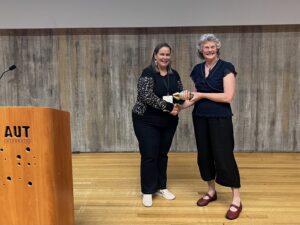
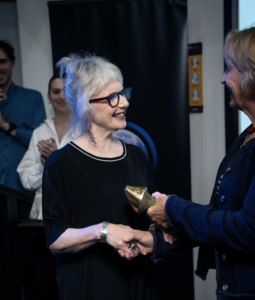
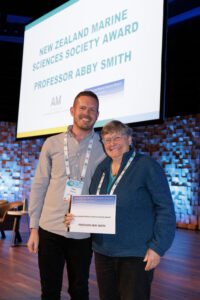
This highly prestigious award was inaugurated in 1985. The award is presented to a person who, in the opinion of the NZMSS Council, has participated in the activities of the Society, has represented the interests of the Society, and has been instrumental in the Society achieving its objective of the advancement of marine science in New Zealand. The award recognises “a person’s continued outstanding contribution to marine science in New Zealand”.
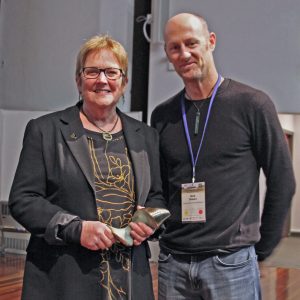
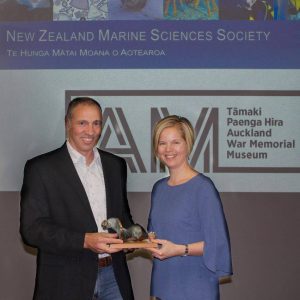
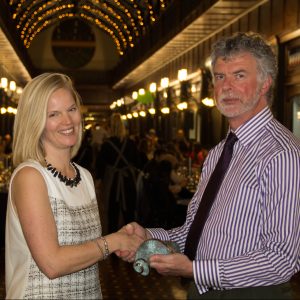
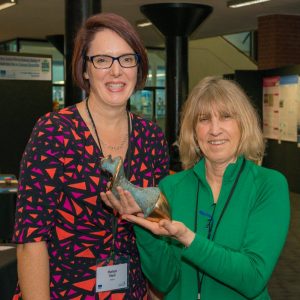
The award is a bronze sculpture in the form of the internal spire of a gastropod shell. It was designed and manufactured by Wellington artist Nick Dryden, and comes with an engraved plaque. The award carries with it lifetime membership of the Society. In accepting the Award the recipient agrees to continue promoting marine science in New Zealand by giving two or more public lectures on a topic of their own choosing. NZMSS awards are presented to individuals in recognition of their continued and outstanding contribution to marine science in New Zealand. Well done!

NZMSS Award Nomination Procedure
Any Society member can make a nomination to the Secretary using the 2012 form available. Please send to secretary@nzmss.org The nomination due date is May 1. The Council may seek further information about the nominee. The Council will choose the recipient from the nominations, and all nominations remain confidential to the Council. The award is presented at the NZMSS annual conference. The award need not be given every year.

RECIPIENTS:

Recipients of the award are chosen by the Council from nominations submitted by any member of the Society. Nominations are considered annually but the Council need not present an award each year. The three awards bestowed in the inaugural year, on scientists considered to be “founders of marine science in New Zealand”, honoured work on ocean physics, marine geology and marine ecology. The subsequent recipients have made their contributions across an equally broad spectrum of marine science endeavour.

2010 Simon Thrush: He was presented the award during the 2010 Marine Sciences Conference dinner held at Te Papa on 8 July. Simon did his undergraduate studies in marine science at the University of Otago, where he received a BSc Honours (1st Class), then went on to do his doctoral work at the University of East Anglia, UK. He then returned to New Zealand as a post-doctoral Fellow (funded by the old University Grants Committee) at Otago University before getting a real job at the Water Quality Centre in Hamilton (1986-1992) and then at the National Institute of Water and Atmospheric Research, where he currently works as a Principal Scientist and the Science Leader in Coastal Ecosystems.

Simon is without doubt the top soft-sediment ecologist in New Zealand and at the very top of his profession worldwide. There are multiple lines of evidence to support this.

• Simon has 151 publications, perhaps another 92 research reports, has done hundreds of seminars and public talks, and has run dozens of workshops in coastal marine science. He is in the top fraction of a percent in citations in his field internationally, with well over 3000 citations of his primary publications.

• He has done internationally significant work in benthic impacts, such as his signal work on the effects of trawling on deep-water communities which has well over 1000 citations.

• He presents numerous scientific talks, public presentations, and end-user workshops annually, is sought after as a keynote speaker in many conferences, and is always both entertaining and highly informative.

• His work in New Zealand is simply outstanding, and is continually published in top international journals.

Taken together, the body of his work places him in the very top echelon of researchers internationally. Recognition in NZ is far overdue for this outstanding scientist, who is at the top of his career.

From his early days as a student at Otago University, Simon has been a deep thinker about ecological processes, the consequences and legacies of human impacts, and the science required both to understand fundamental processes and to underpin management of coastal ecosystems. He now works on many facets of soft-shore ecology with an outstanding team of highly committed and competent scientists at NIWA Hamilton. Their work on “drivers of diversity”, bioturbators, and ecosystem health has been of considerable use nationally and interest internationally. The publicity of his work and ideas, such as in the Ecological Society of America journal Frontiers in Ecology, has brought considerable attention to NZ science. Their extensive work in the bays and estuaries around Auckland, in particular, has produced significant advances in management decisions by the Auckland Regional Council and have aided greatly in development of the coastal management plan.

Simon also co-leads a FRST long-term programme with wide ranging work across marine ecosystems, the Coasts and Oceans OBI (Outcome-Based Investment). This incorporates estuarine, rocky shore and oceanic components of research and is the principle coastal science programme of New Zealand.

Simon is at the very top of his game and will undoubtedly contribute even more to the prestige of NZ marine science in the years to come.


2009 Pamela Mace: A graduate of Canterbury University Pamela has worked in the area of fisheries and was closely involved in the design of the rules that NZ uses to sustainably manage its marine fisheries. The Queen of the Quota Management System and Chief Scientist at MFISH, Wellington.


2008 Malcolm Francis: Malcolm is a Principal Fisheries Scientist at NIWA, Wellington and sharks are his business! He has pioneered tagging and release studies of sharks obtaining valuable depth data and migratory routes by satellites from pop-up tags that were attached to great whites. New Zealand’s foremost shark researcher and a highly skilled underwater photographer. He had a central role in establishing our largest marine reserve around the Kermadec Islands.


2007 Wendy Nelson: An expert in biodiversity of marine macroalgae and coastal ecology. She has had an important role on the New Zealand Conservation Authority. Wendy is based at NIWA in Wellington. During her three decades of research, she has established a notable track record of publications, especially on algal biosystematics and taxonomy.


2005 Dennis Gordon: Dennis is a global authority on the systematics, phylogeny, and biology of living and fossil bryozoans, encrusting animals found everywhere in the sea. He has been involved in international efforts to catalogue world biodiversity(Catalogue of Life and world register of marine species). He coordinated and edited the decade-long project "Inventory of New Zealand Biodiversity" that provides the authoritative names for the New Zealand Organisms Register.


2003 Dave Schiel: Professor David Schiel received the Award as one of New Zealand’s most productive and effective marine scientists. He has made an outstanding contribution to what we know about the NZ paua fishery and more recently to studies of recruitment dynamics and coastal ecology New Zealand-wide, but especially in the South Island.


2002 Bill Ballantine: On the staff of Auckland University 1965-2003 and the first Director of the Leigh Marine Laboratory (1965-1985). One of the key people responsible for establishing the first Marine Reserve at Leigh (1975), Bill devoted his life to the establishment of as many marine reserves as possible around the New Zealand Coast: an idea that encapsulates his views is that all of the New Zealand EEZ should be declared a reserve and that anyone who wanted to use it would have to apply for permission, rather than the situation that we have, where someone has to apply for permission to protect it! Biodiversity needed restoring and limpets were his passion. A tireless campaigner for marine conservation and a strong believer in the need for long term monitoring in the marine environment.


2001 Bruce Hayward: Dr Bruce Hayward is Principal Scientist and owner of Auckland´s Geomarine Research. He and his team of micropaleontologists are the authorities on New Zealand´s modern foraminifera and their application to studies of paleoceanography, sea level rise, coastal earthquakes, and human impacts on the coastal marine environment. His group has determined the timing, architecture and impact of the last global extinction event in the deep sea. Bruce is a former curator of Marine Invertebrates at Auckland Museum where he led studies on the soft sediment ecology and marine invaders in the Waitemata Harbour. He was Scientific Editor of John Morton´s last book "Seashore ecology of New Zealand and the Pacific" and has written 18 of his own books, authored or coauthored 12 scientific monographs and over 240 refereed papers. He was awarded a MNZM for his services to conservation and the establishment of the New Zealand Geopreservation Inventory. He is a past President of the Geological Science Society of NZ and past member of the NZ Conservation Authority.


2000 Bob Creese: A leading light in coastal ecology and former Scientist-in-charge at Leigh Marine Laboratory. His speciality is the ecology of molluscs. At Leigh he conducted research in the fields of marine ecology, conservation biology and aquaculture. Bob has contributed to our knowledge of marine invertebrates & seaweeds, sustainable use of aquatic resources, aquatic pests, monitoring & evaluating change in aquatic ecosystems.


1999 Lionel Carter: Dr Lionel Carter received the Award for his internationally important research across a broad spectrum of oceanography, most notably into abyssal current regimes and sedimentation processes and their links to global climate changes, and also for his significant contribution to seabed monitoring and charting around New Zealand.


1997 John Jillett: Associate Professor John Jillett, Otago University, received the award for his many years of dedicated research on zooplankton (copepods and Munida gregaria) off the Auckland and Otago coasts. It also recognised a huge contribution to marine science through his teaching and administrative duties at the University of Otago and particularly at the Portobello Marine Laboratory (1974-1994).


1996 Chris Francis: Chris Francis, NIWA, Wellington, received the award in recognition of the fundamentally important part that mathematical and statistical analysis play in marine research, as shown by his novel approaches to fisheries modelling, incorporating risk estimates into a simulations.


1995 Vivienne Cassie-Cooper: Dr Cassie-Cooper, Landcare Research, Hamilton, made a huge contribution to the study of microalgae and phytoplankton, including her pioneering achievement of the first survey of marine phytoplankton in coastal waters around New Zealand.


1994 Janet Grieve: A graduate of Canterbury University, Janet received the Award for her achievements as one of New Zealand’s leading biological oceanographers at NIWA, Wellington. She is New Zealand’s foremost authority on the biodiversity of marine planktonic copepods. Janet has investigated the physical and biological processes that govern ocean productivity, and is a strong advocate for the sustainable management of the ocean’s fisheries.


1991 Ron Heath: Was presented the Award for his highly productive research career in oceanography, including his work on tides and on the diffusive advective balance of the sub-tropical convergence, as well as his administrative career with NZ Oceanographic Institute (NZOI) during the 1980s and as Director of the newly established DSIR Division of Marine and Freshwater Science. He later took up a senior administrative role at the University of Otago.


1990 Pat Bergquist: Professor of Zoology, Auckland University in recognition of her many achievements, especially her extensive research on the taxonomy and developmental biology of marine sponges.


1988 John Morton: Professor of Zoology, Auckland University 1960 – 1989; author of classic works on Mollusca, The New Zealand Sea Shore, Native Forests, and Coastal Conservation. One of the leaders who established the Leigh Marine Laboratory, 1962. A product of an age when knowing “Biodiversity” in its totality (including many plants and animals that hardly anyone knew anything about) was essential, this charismatic and somewhat eccentric man was greatly admired as a lecturer and speaker. Initially known as a marine biologist he became a leader in the New Zealand conservation movement of the 1970-80’s.


1986 Howard Choat: Professor of Marine Biology at James Cook University, Townsville, Australia, but formerly the Zoology Department, Auckland University (1969-1985). He carried out now classic research on fish of rocky reefs, especially at the Leigh Marine Reserve. His research includes the biology of Herbivorous Fishes, Including Development and Growth from Larval Stages; the demography and Life Cycles in Reef Fishes and Cephalopods; and evolutionary biology of reef fishes.


1985 Norm Barber: Professor Norm Barber, formerly of Victoria University and a former chief physicist of the Dominion Physical Laboratory. His contribution to understanding the origin, behaviour and travel of ocean waves, made him one of the founders of marine science in New Zealand. In a classic experiment in 1963 a group of wave experts, including Norman Barber, set up wave recording sites that extended across the Pacific Ocean from New Zealand to Alaska. The NZ wave recording site was at the Cape Palliser light house.


1985 Jim Brodie: From 1958 to 1977 he was Director of the NZ Oceanographic Institute (NZOI), the forerunner of NIWA. His expertise was in Quaternary geology and oceanography and he used his skills and knowledge to lead a group that embarked upon fundamental biological, geological and physical studies of our vast offshore region. One might say that he was the “Father” of New Zealand Oceanography.


1985 George Knox: Professor of Zoology, Canterbury University, George was one of the founders of the NZ Marine Science Society. A leading figure in the field of marine science during the 1960’s – 1970’s with a special interest in the biogeography of the southern oceans. Polychaetes were his passion and he was a tireless campaigner for the Marine Environment, a leader of several expeditions to southern off-shore islands and to the Antarctic. The research wing of University of Canterbury field station at Kaikoura bears as name, acknowledging the role that he had in founding the station.


Special Award for Contributions to the Society
At the 2009 conference the NZMSS council presented Bob Hickman with a special award and lifetime membership to recognise his tireless contributions to the NZMSS in every society capacity over many years. Beyond his efforts to NZ marine science in general, Bob's work carried the society through successes and tribulations alike, making it a better organisation promoting and supporting marine science professionals and students. Thanks Bob!